




Thanks to Traders Carnival invite as a speaker, met Shishir from Moneycontrol and i was recently covered by Money Control Pro (Access only to Premium users).
https://www.moneycontrol.com/news/business/markets/guruspeak-manikandan-ramalingam-a-trader-who-excelled-by-teaching-others-4943221.html
As you teach, you learn, is an old proverb, but one that has helped Manikandan Ramalingam (Mani as he is commonly known) become a successful trader. Son of a nuclear scientist, he dabbled with shares in the 2007 market boom. But his biggest learning came when he started the now commonly used site www.bse2nse.com and a YouTube channel by the same name.As the above link is restricted to paid premium users - sharing the article content here.
What started as a discussion board led Mani to take a deep dive into what makes a market work. Mani is an investor as well as an options trader – largely an expiry day trader. He effectively leverages his portfolio to generate alpha by trading options.
When he is not involved with the many activities he has around markets, Mani loves playing badminton and table tennis, though his daughter says he loves sleeping. Working on bringing his weight down, Mani has plans to list his portfolio based on his screener on Smallcase.com, hoping that someday it will be a fund in itself.
In this interaction with Moneycontrol post a meeting at Traders Carnival, Mani opens up on his strategies of investing and trading.
A: The first time I heard about the stock market was when my family visited my father's friend in Chennai who used to deal in stocks fulltime. My father retired from Indira Gandhi Centre for Atomic Research (IGCAR), Kalpakkam as a Group Director. My schooling was in Kalpakkam (Central Govt Township) and Electrical Engineering from Guindy, Tamil Nadu.Q: Can you talk about your education and family background and when was the first time you heard about stock markets?
I liked playing with the numbers. As a kid, one of the games that I loved playing was Tambola (Housie). Though it is a game of luck it requires quick thinking. I
played it every year day-in-day-out in Kalpakkam Carnival which used to happen for a week every August. You need a little skill for spotting quick patterns in numbers on a ticket even though the numbers are randomly called out.
Towards the end, they start going fast with the numbers so one needs to be sharp to claim the prize as soon as you have the winning pattern. Taking quick decisions and recognizing patterns is a common skill in both Tambola and Trading. I later found an immediate liking to the stock market when I heard that it can be done online.
During my 3rd year of college (back in 2005), my college mate shared his excitement of buying his first share in Infosys. I immediately jumped in to open an online account with my pocket money and tried out all kinds of trades possible.
I informed my father about my stock market experiments only in 2007 – six months after getting a job in HP. My father shared his experience of buying L&T back in 1996 and how he could not handle the emotions of ups and downs of the markets and eventually exited any form of stock market investments for good. He told me not to lose myself in the stock market and cautioned that scores of his friends have bet and lost way too much.
Immediately after this incident, my father put me on a home loan (joint loan) which meant that I never had too much money to play around in my first 10 years. This turned out to be a blessing in disguise. I could not lose big even if I wanted to during my early years.
In 2007, IPOs caught my eye. I took an interest-free loan from my company – HP-- and went for listing gains on IPOs. I milked IPOs for listing gains of nearly Rs 2 Lakhs over 2 years till 2008 when the market crashed.
Here I would like to add that from day one I liked my journey in the market. I have felt happy in my early years even though I made losses. I was happy about how much I had learnt by practically testing out and experimenting. I always believed that one way or other I was going to find a way.
At one point, I thought my book sales will be a breakthrough. Website Google Ad revenues and Youtube Ad revenues added more faith. My home loan was over by 2014 and I started building my long term equity portfolio. With each passing year I felt more and more confident that I will be consistent and make it big.
My wife has known more about my journey as an Investor/Trader - she has stood by me through my losses and tough times and has always backed me to go for it.
Q: Post the financial market meltdown what did you do in the markets?
A: I moved into equity as I was always inspired by Warren Buffet. There was an element of trading too where I mainly dabbled with options buying during my initial days.
In these formative days, my college mate urged me to write a blog for the sake of tracking more stocks. That was the start of bse2nse.com and YouTube channel https://www.youtube.com/user/bse2nse later.
This interaction with a much wider audience spiked up my learning curve and perspective of the stock market. One of the forum users asked me to suggest a book on the stock market. Most of the books then were just a dictionary of terms and were not specific to the Indian context. I ended up writing a book myself-- "Art of Stock Investing".
My approach to picking stocks is explained in my book – Art of Stock Investing - which is available free of cost in PDF format. There are 4 basic thumb rules - Debt, Brand Value, Consistent Revenue / Profit Growth and Peer Analysis with examples of 10 companies. It hardly takes an hour to complete the book and I hope it will help someone reduce the learning curve and start building a portfolio directly in stocks.
Apart from this, we look at some technical parameters. On www.bse2nse.com we have a dashboard which filters companies which have done well in the last five years. The core logic of this dashboard is to find companies which went up consistently on an upward channel of 30 or 45 degrees on a monthly chart over the last 5 years. We calculated Bullish percentage of a company as a percentage of time – which is the percentage of time the company’s share price stayed above its 200 days SMA over the last 5 years.
Companies which did well in the last five years tend to do well in the next five years as well. Of course, there are some failures - but the hit ratio is good and the ones which go weak are not a total disaster. An example of a stock which went wrong is Lupin in the pharma sector.
If Virat Kohli was a stock traded on the bourses I would like to have him in my portfolio as he did well in the last 5 years and he has 5 more years left before retirement. He is a good bet in one's portfolio--we try to find Virat Kohlis in the stock market in this dashboard.
The dashboard is also filtered to only show index-based stocks (Nifty 50, Nifty next 50, Nifty Midcap and sector indices). Non-index based stocks are not shown as they are prone to management issues and manipulations. Currently, the most bullish stock as per this logic as on date is Bajaj Finance with 96 percent Bullish
percent – in the last 5 years, its share price has been above its own 200 days SMA 96 percent of the days on a closing price basis.
Q: Initial trading strategies and evolution as a trader
A: I started with plain vanilla one-sided option buying, which later evolved into Strangle – buying out-of-the-money (OTM) call and put options. Years later I ventured into selling a naked option and then selling options with a cover.
Now I have evolved into mixing all up by buying at-the-money (ATM) options and selling OTM options but with an insurance cover or a stop loss.
My process has evolved with my experiences in the market. The longer we play in the market and if we are willing to accept mistakes and learn from it - we will evolve. With more and more data points to work with and changing market dynamics, you sharpen your skills – mastering trading is an ongoing process.
I am constantly experimenting in the live market with new strategies. My worst trade was a result of such an experiment where I shorted twice the options needed to cover my portfolio ending in a loss despite a strong move in the market.
But constant experimentation on live markets is the path to evolution as a trader. You just need to ensure that you don’t lose too much in the process. Self-assess your overall Net Asset Value and ensure you don’t lose too much.
Rest of the article continued below - keep scrolling down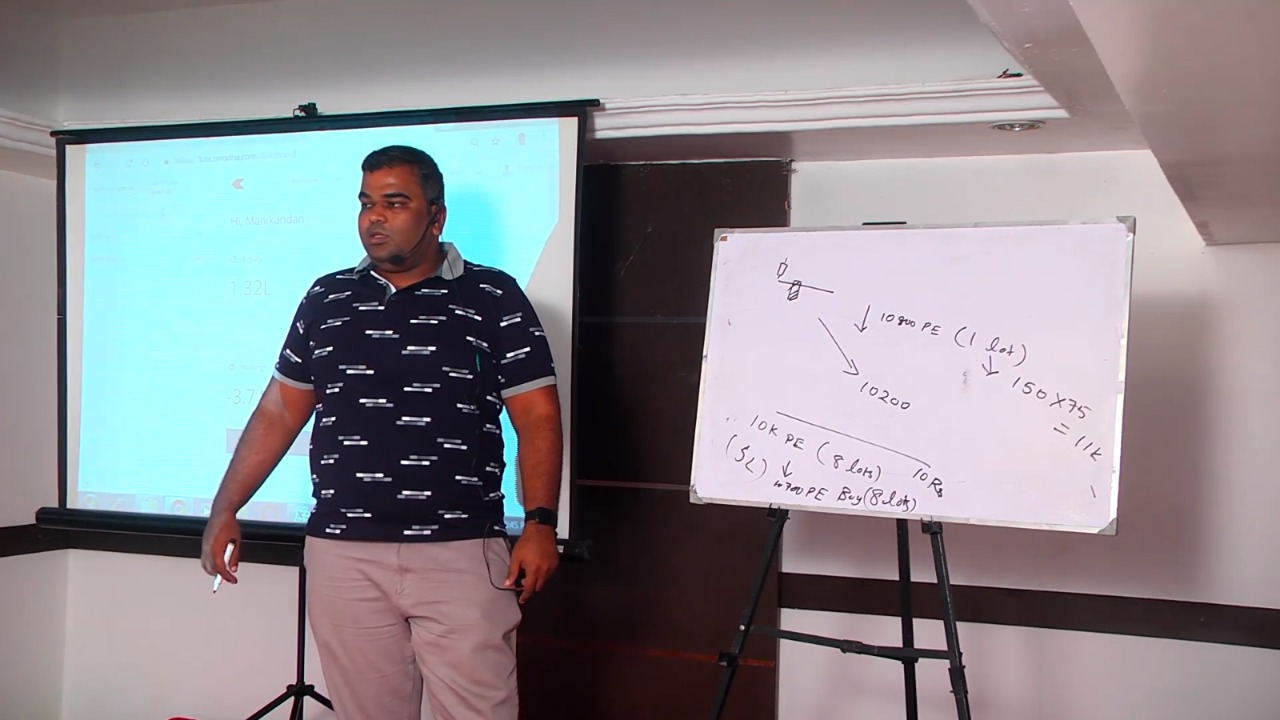
 Register To Reply
